

Redefining sustainable performance
A human system that transforms teams from drained to deeply engaged, and organizations from struggling to flourishing.
The Human Performance Equation
A human-centred framework for sustainable performance and future-ready organizations and individuals
The biggest risk to business performance today isn’t strategy.
It’s human capacity.
Professionals and organizations operate in environments defined by constant change, rising pressure and increasing complexity. Expectations around speed, adaptability, focus and results continue to grow, while the “human system” required to sustain them is under unprecedented strain.
Performance is not breaking down because people lack skills, motivation, or ambition. It is breaking down because the way systems and workplace cultures are designed no longer align with how people actually function and thrive.
The problem beneath performance challenges
Across industries and geographies, organizations are facing a shared pattern: capable, committed people operating under increasing strain, with rising burnout and emotional load.
Leaders are asked to drive change while navigating uncertainty and overload, often stretched between operational demands and the need to support their teams. As a result, trust, psychological safety, and cohesion begin to erode, further challenged by the distance created by hybrid work.
Performance rarely collapses overnight. It erodes gradually when the human foundations behind it are strained and the environment fails to protect the conditions people need to stay engaged and energized.

Why the current model doesn’t work
Most organizations try to improve performance by working on isolated variables:
- leadership development
- wellbeing programs
- change management initiatives
- productivity tools.

Each intervention can be valuable on its own, yet when they are designed and delivered separately, their impact remains limited. They address symptoms, but they miss the underlying system that drives human performance as a whole.
Wellbeing efforts often sit alongside performance goals rather than supporting them, creating a gap between stated intent and lived experience and reinforcing the belief that wellbeing and performance are competing priorities.
Human performance is not linear. It is not the sum of individual skills or initiatives and it cannot be optimised by focusing on one capability at a time. Performance emerges from the interaction of multiple human capacities, especially under pressure. Which is why a different approach is needed – one that recognises the interconnections between these capacities and treats performance as a system. This requires a fundamental shift in perspective: from trying to “fix” individual components to understanding, supporting and strengthening the system as a whole.
The Human Performance Equation
The Human Performance Equation is a science-based framework that enables individuals, teams and leaders to achieve high, sustainable performance while promoting wellbeing, engagement, innovation and measurable business results.
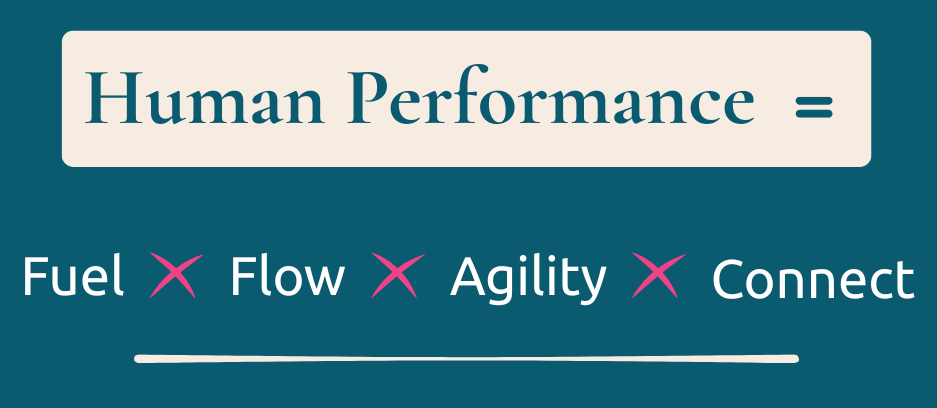
The equation is deliberately multiplicative, not additive; each element plays a distinct role in how people show up, adapt and sustain performance:
- each element strengthens the others
- when one is neglected, the entire system weakens.
This model challenges the long‑held assumption that performance and wellbeing sit on opposite sides of a trade‑off. They are not. Performance without human capacity is short‑lived and wellbeing without performance is incomplete.
The Human Performance Equation gives professionals, leaders and organizations a shared language to understand not only why performance breaks down, but how it can be rebuilt in a way that supports people and strengthens business outcomes.
Fuel
Sustainable Energy and Peak Performance
Fuel is the foundation of sustainable performance. It’s the ability to manage physical, mental and emotional energy so people can stay focused and consistent without burning out. In today’s always‑on environments, attention is constantly pulled, priorities blur and recovery is often treated as optional. Fuel helps people set boundaries, protect deep‑focus time and recharge intentionally, so they can sustain high performance and lead with clarity rather than exhaustion.
Flow
Emotional Awareness and Agility
Pressure amplifies emotion.
Flow is the ability to understand, regulate and navigate emotions rather than being driven by them. It emphasises emotional intelligence as the foundation for managing change, collaborating effectively and leading with impact. Without Flow, change triggers resistance, communication breaks down, teams default to reactive behaviour and performance becomes driven by urgency rather than intention.

Agility
Mindset and Adaptability
Change is no longer sporadic. It is constant. Agility is the capacity to adapt, think critically and navigate uncertainty. It supports resilience, self-leadership and sound decision-making when priorities shift and clarity is limited. Agility enables people to manage complexity without losing direction or confidence.

Connect
Relational intelligence and collaboration
Performance is relational.
Connect is about building strong relationships and fostering collaboration to drive team and organisational results. Connect helps individuals and teams develop trust, communicate clearly and work cohesively to create inclusive and innovative teams. Without strong relational foundations, even highly skilled teams struggle to perform consistently.
Why the Equation Works
The Human Performance Equation is not a wellbeing model, a leadership program or a productivity tool. It’s a strategic framework that brings human capacity and business priorities into one integrated system. When these capacities strengthen together, the impact becomes visible, not just in how people feel, but in how the business performs.
Organizations that invest in strengthening the human capacity see measurable impact across key business dimensions:
- Higher engagement and retention
- Stronger trust and collaboration
- Better change adoption
- Increased productivity and focus
- More resilient, future-ready teams.
Performance becomes sustainable when care, clarity and accountability coexist.
I’ve been trusted by organizations such as:






























THE FOUNDER Paola Elena Brignoli - Human Performance Expert
I have devoted my career to reshaping how people work and lead, helping organizations navigate complexity and continuous change. My focus is on creating environments where people have the right mindsets and tools to enable sustainable high performance and drive meaningful business results.
The Human Performance Equation is the result of years spent observing what enables people and teams to perform sustainably, integrating behavioral science with hands‑on experience across more than 35 global organizations.
By combining corporate experience with a deep understanding of the science of human flourishing, I collaborate with HR and L&D partners, leaders and teams to build organisations that are equipped to meet future challenges from the inside out.
This is the approach I have brought to global organizations such as Nike, ING Luxembourg and Paula’s Choice.
FAQ - Human Performance Equation
Yes, in fact, this is where the model is most effective.
The Human Performance Equation was designed specifically for contexts where pressure, responsibility and complexity are high.
Rather than trying to reduce pressure, the framework strengthens the human capacity required to operate effectively within it.
No.
The Human Performance Equation can be applied at three different levels:
- individual professionals
- leaders and leadership teams
- organizations and their people development, culture and wellbeing strategies
The framework remains the same, but the level of application changes.
It can support an individual leader navigating complexity just as effectively as it can support an organization build a culture of high, sustainable performance.
No.
Leadership development is one possible application of the framework, but the Human Performance Equation is broader and more versatile.
It is a human performance framework that can support:
- leadership development
- organisational culture transformation
- team effectiveness.
The Human Performance Equation is particularly relevant for:
- HR leaders and L&D professionals redesigning leadership, culture and people development strategies
- organizations facing challenges with engagement, talent retention or reorganization
- leadership teams navigating change, uncertainty and increasing complexity
- senior professionals operating in high‑pressure or high‑stakes environments
- individuals experiencing overload, decision fatigue or an unsustainable pace.
The framework is designed to support situations such as:
- sustained pressure, overload and high cognitive demands
- difficulty maintaining emotional agility and resilience under stress
- complex decision‑making and reduced adaptability in fast‑changing environments
- leadership transitions and leading through uncertainty
- declining engagement, trust or collaboration within teams
No.
While the Human Performance Equation supports wellbeing, its primary purpose is sustainable high performance.
The model strengthens the human capacities that enable people to focus, decide, collaborate and adapt effectively under pressure.
The Human Performance Equation can be applied through different formats depending on organisational needs:
- leadership workshops and development programs
- team interventions
- keynote sessions
- strategic advisory for HR and leadership teams
- 1:1 Human Performance Coaching
Interventions can be delivered independently as stand‑alone experiences or as part of a longer, more comprehensive development journey.
No.
The framework offers a clear structure and shared language, but each intervention is tailored to the organisation’s context, challenges and strategic priorities.
The aim isn’t to apply a rigid method – it’s to strengthen the specific human capacities the system needs most.
The best starting point is to plan a short introductory conversation to understand the specific challenges your organization or leadership team is facing.
From there, the most relevant route – whether a workshop, a leadership program or individual coaching – can be identified and shaped around your specific context.